Monday, June 24, 2013

AMD Radeon HD 7990 Review: 7990 Gets Official

Officially canonized back in 2008 with AMD’s “small die” strategy, dual-GPU cards have since become a staple of AMD’s product lineup. Filling a small-but-important niche for AMD, dual-GPU cards allow AMD to both deliver ultra-enthusiast performance levels their traditional single-GPU products can’t offer, and at the same time compete with NVIDIA’s big die flagship cards without AMD needing to produce a big die GPU of their own. As a result, though these cards aren’t necessarily obligatory, with each generation we’re left eagerly awaiting just what AMD has in store for their capstone product.
Of course with that said, like so many other facets of the 7000 series, the dual-GPU situation has played out rather unusually in the past year. In a typical year we would see AMD release a standard design, and then later on partners like Asus and PowerColor would release their own custom designs in the name of product differentiation and squeezing out just a bit more performance. Instead the 7000 series has played out in reverse: Asus and PowerColor released their designs first. Consequently, up until this point the 7990 has been “officially unofficial”, reflecting the fact that the first 7990s were AMD sanctioned products, but not based on AMD designs.
But at long last the 7990 is becoming fully official. AMD is getting into the game with their own 7990 design, and perhaps more importantly they’re doing so while coming to bear with the kind of engineering resources that only a GPU manufacturer can provide. This isn’t going to be the first 7990 – that honor belongs to PowerColor’s 7990 – but this is unquestionably the most important 7990.  For AMD and their partners going official doesn’t just mean the AMD is taking a greater role in matters, but as we’ll see it means changing the rules of the game entirely.
AMD GPU Specification Comparison
  AMD Radeon HD 7990 AMD Radeon HD 7970 GHz Edition AMD Radeon HD 7970 AMD Radeon HD 6990
Stream Processors 2 x 2048 2048 2048 2 x 1536
Texture Units 2 x 128 128 128 2 x 96
ROPs 2 x 32 32 32 2 x 32
Core Clock 950MHz 1000MHz 925MHz 830MHz
Boost Clock 1000MHz 1050MHz N/A N/A
Memory Clock 6GHz GDDR5 6GHz GDDR5 5.5GHz GDDR5 5GHz GDDR5
Memory Bus Width 2 x 384-bit 384-bit 384-bit 2 x 256-bit
VRAM 2 x 3GB 3GB 3GB 2 x 2GB
FP64 1/4 1/4 1/4 1/4
Transistor Count 2 x 4.31B 4.31B 4.31B 2 x 2.64B
PowerTune Limit/TDP 375W 250W+ 250W 375W
Manufacturing Process TSMC 28nm TSMC 28nm TSMC 28nm TSMC 40nm
Architecture GCN GCN GCN VLIW4
Launch Date 04/23/2013 06/22/2012 01/09/2012 03/11/2011
Launch Price $999 $499 $549 $699
Diving right into the thick of things, like the officially unofficial cards before it, AMD’s 7990 is a dual-Tahiti part, placing two of AMD’s flagship GPUs on a single PCB to make a single card. AMD has held nothing back and these are fully enabled GPUs, so each GPU has all 2048 stream processors, 32 ROPs, and their full 384-bit memory buses present. Joining these GPUs is 6GB of GDDR5 RAM, split up between the two GPUs for the 7900-series standard of 3GB of VRAM per GPU.
The big question with any dual-GPU card of course is what kinds of clockspeeds it can run at, and as a turns out the 7990 can clock rather high. The 7990 is a PowerTune Boost part like the 7970GE it’s based on, giving the card a base clockspeed of 950MHz, and a boost clock of 1000MHz. Meanwhile the memory is clocked at 6GHz, the same as the 7970GE. As a result the 7990 is surprisingly close to being a 7970GE Crossfire setup on a single card, clocked just 50MHz below AMD’s single-GPU flagship card. In fact this is better than some of the earlier 7990s such as PowerColor’s, which were clocked lower and simultaneously lacked PT Boost.
But perhaps the most defining aspect of AMD’s 7990, and the thing that sets it apart from unofficial 7990s that came before it is the TDP. AMD’s 7990 has an official TDP of just 375W, which although common for official dual-GPU cards, is quite a bit lower than the TDPs of the unofficial 7990s. As the GPU manufacturer AMD has the ability to do finely grained binning that their partners cannot, so while Asus and PowerColor have essentially been putting together cards that really are two 7970s on a single card – right down to the TDP – official 7990s get the advantage of AMD’s binning process, significantly reducing power consumption. The end result is that while an unofficial 7990 would be a 450W+ part, AMD can deliver the same or better performance while consuming much less power, putting the 7990 within the all-important 375W envelope that OEMs and boutique builders look for.
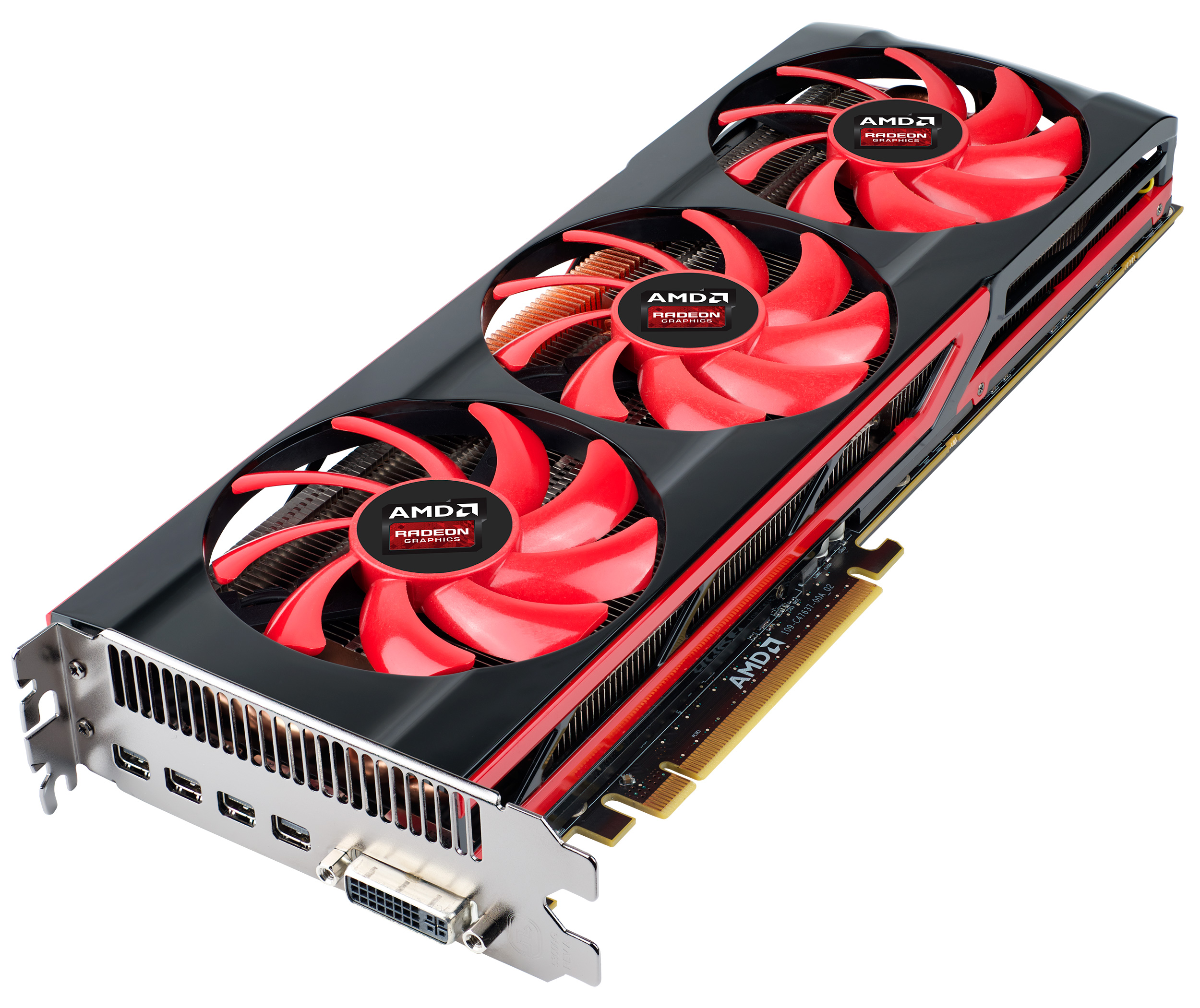
While we’re on the subject of power, this is the first official AMD dual-GPU part to include AMD’s ZeroCore power technology, which was introduced with the GCN family. ZeroCore as you might recall allows AMD to almost completely shut off slave GPUs when they’re not in use, which in turn allows AMD to further reduce their idle power consumption. The biggest benefits are found in multi-card setups since this allows the fans on those slave cards to be shut down, but even on the 7990 it still provides a benefit by allowing AMD to curtail their idle power consumption. Consequently this pushes the idle TDP of the 7990 down to around 20W, which is greater than a single card, but a clear improvement over 6990 and earlier AMD dual-GPU cards.
Moving on to product stacks and competition, it comes as no great surprise that AMD is placing their newest flagship part directly opposite NVIDIA’s flagship cards. AMD doesn’t produce a GPU equivalent to GTX Titan’s massive GK110 GPU, so the 7990 is AMD’s official answer to both Titan and NVIDIA’s own dual-GPU card, the nearly year-old GTX 690. In the case of the GTX 690 it’s a rather straightforward matchup since both cards are based on the same principles, while against Titan AMD needs to make a case about raw performance versus the inherent simplicity of a single-GPU solution over a dual-GPU solution.
Along those lines, since AMD is placing the 7990 against NVIDIA’s flagships they will also be pricing it directly against NVIDIA’s flagships, setting the MSRP for the 7990 at $999. This steep price tag raised some ire with the GTX 690 and with GTX Titan, and it likely will here once more. But with single 7970GEs still regularly going for $400-$500 and the fact that AMD is throwing in their best Tahiti chips into 7990, there’s little incentive to charge less. A 7970GE CF setup will be both faster and cheaper, but as a pair of those cards take up 6 slots after accounting for cooling needs, AMD can bank on the fact that the 7990 is essentially the same size as a 7970GE, charging a premium for the size advantage.
Ultimately customers interested in the 7990 will have a bit of time to sit on the matter and decide if they want one. The 7990 is being launched ahead of its actual retail availability, with AMD telling us the cards will hit etailers within two weeks. Meanwhile all of AMD’s usual partners will be participating on this 7990, so expect to see 7990 cards from all of major AMD partners, and sold at all of the major etailers.
Finally, AMD has been having a blast with game bundles over the last few months, and they won’t be stopping with the 7990. In a game bundle that quite frankly I cannot recall being rivaled by anything else done in the last 20 years, AMD will be bundling the 7990 with 8 different games from the current and past Never Settle bundles. All of AMD’s current bundle titles are included: Crysis 3, Bioshock Infinite, Tomb Raider, and Far Cry 3: Blood Dragon. Along with that AMD is also packing in the best games out of their previous bundles: Far Cry 3, Hitman: Absolution, Sleeping Dogs, and Deus Ex: Human Revolution. Simply put, 7990 buyers will be well-stocked for games to play on their new video card.
Meanwhile on housekeeping note, AMD will be changing how vouchers are distributed for the 7990; rather than having etailers distribute the vouchers with qualifying purchases, AMD’s partners will be packing the vouchers into the product box. Though the etailers have been good about including vouchers, they do at times forget them. So for the 7990 AMD and their partners aren’t going to be taking any chances.
April 2013 GPU Pricing Comparison
AMD Price NVIDIA
AMD Radeon HD 7990 $1000 GeForce GTX Titan/GTX 690
PowerColor Radeon HD 7990 $900  
Radeon HD 7970 GHz Edition $450 GeForce GTX 680
Radeon HD 7970 $390  
  $350 GeForce GTX 670
Radeon HD 7950 $300  

Friday, June 21, 2013

4th Generation Intel® Core™  i7 Processor

Amazing performance and stunning visuals at their best. Get top-of-the-line performance for your most demanding tasks with a 4th generation Intel® Core™ i7 processor. For a difference you can see and feel in HD and 3-D, multitasking and multimedia, the 4th generation Intel Core i7 processor is perfect for all your most demanding tasks.
Effortlessly move through applications with smart multitasking from Intel® Hyper-Threading Technology1. Enjoy the thrill of an automatic burst of speed when you need it with Intel® Turbo Boost Technology 2.02. Experience your movies, photos, and games smoothly and seamlessly with a suite of built-in visual enhancements—no extra hardware required3.
Get a boost in performance you can see and feel, along with longer battery life, built-in security for deeper protection4, and extra peace of mind from enhanced security. Choose the 4th generation Intel Core i7 processor for whatever you want to accomplish. Because the only thing more amazing than Intel® technology is what you’ll do with it.
Additional performance information: 5

Product Brief:  Preview |  Download


Specifications

Processor Number Cache Clock Speed # of Cores/
# of Threads
Max TDP/
Power
Memory Types Graphics
Intel® Core™ i7-4950HQ Processor (6M Cache, up to 3.60 GHz) 6.0 MB 2.40 GHz 4 / 8 47 DDR3L-1333,1600 Intel® Iris™ Pro graphics 5200
Intel® Core™ i7-4850HQ Processor (6M Cache, up to 3.50 GHz) 6.0 MB 2.30 GHz 4 / 8 47 DDR3L-1333,1600 Intel® Iris™ Pro graphics 5200
Intel® Core™ i7-4750HQ Processor (6M Cache, up to 3.20 GHz) 6.0 MB 2.00 GHz 4 / 8 47 DDR3L-1333,1600 Intel® Iris™ Pro graphics 5200
Intel® Core™ i7-4770R Processor (6M Cache, up to 3.90 GHz) 6.0 MB 3.20 GHz 4 / 8 65 DDR3L-1333/1600 Intel® Iris™ Pro graphics 5200

4th Generation Intel® Core™ i5 Processor


Less waiting. More doing. Multitask up to 4x faster.
Discover the thrill of an automatic burst of speed when you need it with Intel® Turbo Boost Technology 2.0. 1 Experience your movies, photos, and games smoothly and seamlessly with a built-in suite of visual enhancements3—and enjoy them even more with longer battery life.
Get a boost in your performance that you can truly see and feel, along with extra peace
 of mind from enhanced security. Because the only thing more amazing than Intel® technology is what you’ll do with it.
Additional performance information: 4, 5
Product Brief:  Preview |  Download


Specifications


Processor Number Cache Clock Speed # of Cores/
# of Threads
Max TDP/
Power
Memory Types Graphics
Intel® Core™ i5-4570R Processor (4M Cache, up to 3.20 GHz) 4.0 MB 2.70 GHz 4 / 4 65 DDR3L-1333/1600 Intel® Iris™ Pro graphics 5200
Intel® Core™ i5-4670R Processor (4M Cache, up to 3.70 GHz) 4.0 MB 3.00 GHz 4 / 4 65 DDR3L-1333/1600 Intel® Iris™ Pro graphics 5200
Intel® Core™ i5-4250U Processor (3M Cache, up to 2.60 GHz) 3.0 MB 1.30 GHz 2 / 4 15 DDR3L-1333/1600; LPDDR3-1333/1600 Intel® HD graphics 5000
Intel® Core™ i5-4350U Processor (3M Cache, up to 2.90 GHz) 3.0 MB 1.40 GHz 2 / 4 15 DDR3L-1333/1600; LPDDR3-1333/1600 Intel® HD graphics 5000
 

4th Generation Intel® Core™ i3 Processor

Amazing performance and stunning visuals start here. Get a smooth, seamless visual experience with a 4th generation Intel® Core™ i3 processor, featuring longer battery life and built-in security for deeper protection.1

Effortlessly move among applications with smart multitasking from Intel® Hyper-Threading Technology2. Experience your movies, photos, and games smoothly and seamlessly with a suite of built-in visual enhancements—no extra hardware required3.
Get a difference in performance that you can truly see and feel, along with peace of mind from enhanced security and better flexibility with longer battery life. Because the only thing more amazing than Intel® technology is what you’ll do with it.

Additional performance information: 4
Product Brief:  Preview |  Download
Supported System Types:
Intel® Core™ i3 Processors

Specifications

Processor Number Cache Clock Speed # of Cores/
# of Threads
Max TDP/
Power
Memory Types Graphics
Intel® Core™ i3-4010U Processor (3M Cache, 1.70 GHz) 3.0 MB 1.70 GHz 2 / 4 15 DDR3L-1333/1600; LPDDR3-1333/1600 Intel® HD Graphics 4400
Intel® Core™ i3-4100U Processor (3M Cache, 1.80 GHz) 3.0 MB 1.80 GHz 2 / 4 15 DDR3L-1333/1600; LPDDR3-1333/1600 Intel® HD Graphics 4400
Intel® Core™ i3-4010Y Processor (3M Cache, 1.30 GHz) 3.0 MB 1.30 GHz 2 / 4
DDR3L-1333/1600, LPDDR3-1333/1600 Intel® HD Graphics 4200
Intel® Core™ i3-4158U Processor (3M Cache, 2.00 GHz) 3.0 MB 2.00 GHz 2 / 4 28 DDR3L-1333/1600 Intel® Iris™ graphics 5100

Intel® Solid-State Drive DC S3500 Series

Intel® Solid-State Drive DC S3500 Series

Consistently amazing

The Intel® SSD DC S3500 Series combines fast, consistent read performance with strong data protection and low active power levels to provide superior quality of service for video conferencing, big data analytics, or virtual client applications. Consistently low read latencies of 50µs typical (500µs max for 99.9% of the time) along with a tight distribution of up to 75,000 input/output per second (IOPS)1 delivers a high-performance, reliable, and efficient SSD specifically designed for data center application upgrades.
Key features and benefits of this drive include an Intel® 3rd generation controller, industry-leading 20nm multi-level cell (MLC) NAND flash technology, full end-to-end data protection, enhanced power-loss data protection, and a broad range of capacities up to 800GB.
Product Brief:  Preview |  Download
Product Specification:  Preview |  Download
Supported System Types:

Capacity Sequential Read/Write (up to)1 Random 4KB Read (up to)/Write (up to)2 Form Factor
80GB SATA 6 Gb/s      340 MB/s / 100 MB/s 70,000 IOPS / 7,000 IOPS 2.5 and 1.8-inch SATA
120GB SATA 6 Gb/s      445 MB/s / 135 MB/s 75,000 IOPS / 4,600 IOPS 2.5-inch SATA
160GB SATA 6 Gb/s      475 MB/s / 175 MB/s 75,000 IOPS / 7,500 IOPS 2.5-inch SATA
240GB SATA 6 Gb/s      500 MB/s / 260 MB/s 75,000 IOPS / 7,500 IOPS 2.5 and 1.8-inch SATA
300GB SATA 6 Gb/s      500 MB/s / 315 MB/s 75,000 IOPS / 9,000 IOPS 2.5-inch SATA
400GB SATA 6 Gb/s      500 MB/s / 380 MB/s 75,000 IOPS / 11,000 IOPS 1.8-inch SATA
480GB SATA 6 Gb/s      500 MB/s / 410 MB/s 75,000 IOPS / 11,000 IOPS 2.5-inch SATA
600GB SATA 6 Gb/s      500 MB/s / 410 MB/s 75,000 IOPS / 11,000 IOPS 2.5-inch SATA
800GB SATA 6 Gb/s      500 MB/s / 450 MB/s 75,000 IOPS / 11,500 IOPS 2.5 and 1.8-inch SATA

Intel® Desktop Board DZ87KLT-75K

Intel® Desktop Board DZ87KLT-75K

Intel® Desktop Board DZ87KLT-75K
Whether you are into extreme gaming, overclocking, or high-end video manipulation, Intel® Desktop Board DZ87KLT-75K is the motherboard for you. This board has been highly optimized for the Intel® –K processor line to take full advantage of all that the processor family has to offer.
Support for CrossFireX* and SLI*, USB 3.0, SATA 6 Gb/s, and dual LAN allows endless connection possibilities. And if you enjoy pushing the envelope with the ultimate in connectivity, this board offers on-board Thunderbolt™ technology for blistering bidirectional 10 Gb/s transfer rates.
Nothing moves content in and out of your system faster. All this in a board from Intel—your trusted technology team.
Product Brief:  Preview |  Download
Supported System Types:
Features and configurations
Form factor
ATX
AA# (Altered Assembly)
G74721-xxx
BIOS ID string
KLZ8711D.86A
Processor
Supports the 4th generation Intel® Core™ i7 processor, Intel® Core™ i5 processor and other Intel® processors in the LGA1150 package, highly optimized for the Intel® –K processor line
Memory
  • Dual channel DDR3 2400+MHz O.C, DDR3 1600/1333 MHz,
  • Supports Intel® Extreme Memory Profile (Intel® XMP)
  • Support for up to 32 GB of system memory
Chipset
Display
  • Three PCI Express* 3.0 x16 graphics slots (switchable to x8 or x4)
  • Supports ATI CrossfireX* and NVIDIA SLI*
  • HDMI* display connector
Audio
Intel® High Definition Audio1 subsystem in the following configuration:
  • 10-channel (8+2) Intel® High Definition Audio
  • Five stack analog audio ports with optical S/PDIF out and S/PDIF header
  • Front panel microphone/headphone header
LAN support
Gigabit Ethernet controller
Peripheral interfaces
  • Eight USB 2.0 ports (two back panel ports, six via internal headers – includes two high-current back panel ports and two high-current internal ports for charging)
  • Eight USB 3.0 ports (six back panel ports, two via internal headers )
  • One PS/2 connector (keyboard or mouse)
Expansion capabilities

Wednesday, June 19, 2013

Computex 2013: Intel and Windows 8 Convertibles - Samsung